

Being a mum is a wonderful and rewarding experience, but it can also be challenging and overwhelming at times. In this episode, we’ll discuss the importance of setting healthy boundaries as a mum, and how doing so can help you navigate the ups and downs of motherhood with greater ease and confidence.
As a mum, you may feel pressure to do it all and be everything to everyone. However, setting healthy boundaries can help you avoid burnout, feel more in control of your life, and build stronger and healthier relationships with your children and partner. We’ll explore practical tips for setting boundaries around your time, energy, emotions, and personal space, so you can create a more fulfilling and balanced life for yourself and your family.
ad disclosure – this post may contain affiliate links
Table Of Contents
Can’t Listen Right Now? Read On Instead…
Hi guys! Welcome back to another episode of Real Talk with Rhi. Hello! How are you? How have you been?
Today we are talking about a very important topic, but I think it’s something that a lot of us women, especially mothers, struggle with, and that is boundaries.
Which boundaries we should be setting in our lives, which boundaries we should be enforcing? Failure to set the right boundaries can cause so many problems.
We’re going to be looking at why boundaries are so important, especially for mums and how we can go about setting these effectively in our lives. We all know motherhood can be so chaotic.
It’s easy to get overwhelmed and overstretched.
We’ve got demands from family, from work, from friends, commitments. But it’s so important to recognise that we can’t do it all. We can do anything, but we can’t do everything.
Let’s get into this chat about boundaries, why they can be hard to set and maintain, and how we can get over that, and how we can start creating healthy boundaries in our lives. Let’s go.
So why do we have a lack of boundaries in our lives generally as women, as mothers? And I think it’s probably different for everyone. But for me, and I think for a lot of people who I talk to in real life or in my dms, in my comment sections, in my videos,
A lot of this lack of boundaries comes from feeling like if we’re not doing it all, we’re not doing a good job.
Saying no to people makes us a bad person or not a good girl. And it comes back to these stories we have from childhood. It comes back to people pleasing and just wanting to be a good girl and keep everyone happy.
But there are so many negative impacts when we fail to set effective boundaries in our lives. I know I have been guilty of this so many times, and what it’s important to remember is that if we’re not saying no, to this thing we’re being asked, we are inadvertently saying no to something else.
For example, you say yes to helping out with an event at the school. Really worthwhile event. You want to be involved, but you genuinely don’t have time to do it. By saying yes to that, you are saying no to something else. Maybe that no is spending time with your family or fitting in some work you could have been doing to earn money or sleeping.
You are saying no to one of those other things by not saying no and saying yes to the event. This hypothetical event that you’re helping with at the school. That you really don’t have time to do and get involved with.
Let’s start with looking at some negative things that happen when we don’t set these boundaries and the impact this can have.
Then we’re gonna move on to some examples of healthy boundaries that we can set,
both with ourselves and others. How we can start to implement them and how we can overcome the roadblocks that we may come up against as we start to implement these boundaries, possibly for the first time.
So what ends up happening really, if we don’t set effective boundaries?
We can end up feeling overwhelmed, stressed, and anxious. And this has an impact, yes, on ourselves massively. It can impact your mental health, your physical health, but also it impacts the people around you. So the people you love, the people you’re trying to care for, your children, your partner, your wider family, your friends are going to feel that impact because if you are stressed and anxious and overwhelmed, then you are not showing up as your best self.
You are not giving the best of yourself to the people you care about.
If you are at the beginning of the setting boundaries process and you are struggling to do it for yourself, you can do it for those around you. You can do it to be the best self for those around you so therefore, to show up for them. And you should totally be able to do things for yourself, but equally I understand that can be a difficult place to get to. So that’s a good starting point if you are struggling to do it for yourself.
Which brings me to my next one, which is if you are struggling to set effective boundaries, you can end up feeling resentment to others. When you are feeling overstretched, it’s so easy to resent those around you, the people putting demands on you, even the people putting the standard demands on you, not necessarily from the people who are putting these new demands on you, but when you are stretched thin, all of the demands on you feel more intense, and I’m sure if you have children, this is something you felt at some point.
I know I have.
So in reality, failing to say no and set these effective boundaries is kind of a one-way street towards burnout. And I know so many mums are really walking that very fine tight rope, hovering over burnout so much of the time. So we’re going to look at which boundaries we can set in order to avoid that and just make the path a little smoother.
We’re not quite so close to tipping over into that burnout stage.
Failing to have proper boundaries can also mean that you feel guilty, you’re not doing enough, because you end up in this kind of shame spiral of being overworked, being fried, being spread too thin, and then feeling like you’re not really doing a good enough job at anything. I think this is a really common phenomenon for mums that we just constantly feel like we are not good enough, which is awful. We should not be made to feel like that, but by spreading ourselves too thin, it’s just how we end up feeling. Speaking from personal experience, I can totally say that this is how I have felt in certain periods of my life for long stretches.
Not setting proper boundaries means you can suffer from like a loss of personal identity.
You can struggle with setting priorities.
You end up not having enough time for yourself, which again, compromises your mental and physical health, which comes back to the first point where you cannot be mentally and physically healthy for yourself and for your family.
So that’s why we need to set these healthy boundaries, guys. I think it’s something we all know deep down, but when we’re caught on this kind of hamster wheel of trying to keep everyone happy, trying to spread ourselves too thin, it can be easy to forget.
We’re gonna split the boundaries here into two sections. There are boundaries you can set with other people and boundaries we can set with ourselves.
Let’s start with the boundaries that we might need to set with other people. I think these are the boundaries that we think of initially, but there are definitely boundaries we need to set with ourselves. So stay tuned and we will get to that, but start with other people first.
So one example might be communication preferences.
You can let others know when you are available to talk and when you’re not available to talk.
Now, you don’t need to confuse this with being rude. It is not rude or unacceptable to be unavailable at certain times of the day or week to speak to people or communicate with people.
An example might be work you are available between these set hours for work communication when you are in work.
Maybe you have a boundary where you will check your email at a certain time, over the weekend, you would respond to anything urgent. Maybe your boundary is that you will not do that, and by making this boundary clear with the people you work with, then it’s going to avoid confrontation, nasty feelings, unease, and just conflict down the line.
A really good example of this is I’ve started setting up out of office email autoresponders when I’m away so that if I get incoming work from PRS and brand work, things like that, and I don’t respond to it straight away because I’m away, they know that’s because I’m out of office and not because I am just being rude or unreliable.
If you work for an employer, you can do the same thing so that people know you are not going to see that email. They’re not like, oh, why isn’t you responded to that then? You know there is an out of office on your email, so you know people are not expecting you to respond to that email, and therefore, no one’s offended. Easy boundary to set up and it frees up your evenings and weekends not feeling guilty you should be checking your emails.
You can set these boundaries personally too.
There is actually a facility called Focus Modes on the iPhone where you can notify people via text message automatically that you are not seeing that message because you are driving, you are working, you’ve got do not disturb on whatever it might be.
I’ve had to set up a boundary, which is very difficult when you work from home. If you’re watching on YouTube, shout out in the comments below if you find this difficulty working from home too. But when you’re in an office, people understand you can’t answer the phone because your boss is there, so you can’t answer the phone.
But if you’re working from home, people find it very difficult to understand why you can’t just have a chat in the middle of the day. And when you are self-employed, obviously you have to be your own boss. You’ve gotta be strict with yourself, otherwise no one else will. So I’ve had to set up this boundary where I don’t chat on the phone during my office hours, which is when my children are in school, so that I can focus on work and therefore be more free and available for my children when they get home. And this has been a difficult boundary to set with certain people in my life who struggle to understand this. It’s like, you are at home. Why can’t I just call in and have a chat? Why can’t I just speak to you on the phone?
Well, you can’t because I’m working. And if I was in work. In an office, you wouldn’t expect that.
While that has been a challenging boundary to establish, I feel like it’s a really important one because by saying yes to having that chat during my working time, I am saying no to spending that chunk of time with my children on the weekend.
Hence why it’s an important boundary.
Another one can be time boundaries to set with friends, family, colleagues. When you just notify people how much time you’ve got for something. If someone wants to call in to visit, but you know your children have got activities that they’ve got dinner, whatever, bedtime that you say, look, “we’d love to see you, we’d love for you to call in, as long as you understand I have to feed the children at this time. I have to take the children to karate at that time. I’ve got to get them to bed by this time. We’d absolutely love to see you, but unfortunately, we are going to have to fit around that routine in order for the children to get to their extracurricular activities and get to bed in time for school the next morning to get up and feel fresh.
It can be sometimes really awkward when you know people are visiting and they’re still there and you need to be getting the children to bed, or fed or whatever it might be and I definitely used to struggle with this when my children were smaller and they were on routines and things and learning to say I’m going to have to do this now, can be tricky, but the implications of keeping the children up later, for example, on a school night, mean a nightmare following morning when you’re trying to get them up and ready and you are regretting your life choice not enforcing that prompt bedtime because ultimately it’s the children who are suffering.
Another example of boundaries to set can obviously be physical boundaries. What are you comfortable with? I think as millennial adults, we can all think back to , that one auntie that wanted to give us a hug and a kiss and think to when we didn’t really want to.
And I think now with our children, we’re a little bit more respectful of informed consent and reminding children that they only have to do what they’re comfortable with, not forcing them to hug and kiss people when they just don’t want to.
And I think as adults, we need to remember that we need to be comfortable with our own boundaries so that we can model this behavior for our children.
And this goes for all our boundaries really. If our children see us being treated badly by a partner, they will think it’s okay to be treated badly by a partner. If our children see us being run ragged by a boss and having no boundaries and answering every email, they’ll think that is quote unquote normal, and how they will have to behave when they are older.
Even if they don’t consciously agree with it, they’re going to end up with that subconscious limiting belief. They’re going to end up with that subconscious limiting belief that that is okay.
So, which physical boundaries do you want to set?
Be okay with not wanting to hug a certain person, if that makes you uncomfortable. And I guess this goes a bit of a two-way street as well. It’s a kind of a read the room kind of thing. If you are a hugger, you know, other people are not.
Just kind of meeting people where they’re at, where their boundaries are too, especially where physical contact is concerned.
Another boundary it can be really important to enforce is one of personal space. So when you need some time to just decompress, be quiet, be on your own.
It’s really funny actually, because I never thought of myself as an introvert. I danced when I was younger. I was always in shows, obviously, with what I do for a living, I don’t think I necessarily come across as quiet or shy,
and yet since the pandemic, I’ve realised more and more how much I actually like my own company. I have worked in office environments before and actually found it a really stressful experience and the idea now of having to go back into an office environment, be surrounded by lots of people all the time and not having quiet time to work, I found that idea quite stressful.
So I think maybe I might be an introvert and I’ve realized that having time on my own to journal or exercise or watch just the rubbish TV that I want to watch, read a book, whatever it might be, is really precious time.
And I know, having time, that quiet time as a mother is, it’s like unicorn poop, isn’t it? It’s, it’s very difficult to find. It is not the kind of thing that is easily available and in abundance in a lot of our lives.
So this is part of the reason that I’ve established a morning routine because there are things that I, I’m not gonna say I want to do, but I know I feel better when I do.
So, for example, Exercise is something that I have to do if I want to feel energised, good in my body, and avoid having to have physio, all the darn time because I do have issues with my shoulders, uh, kind of hangover issues from childbirth and things around my hips, and when I don’t exercise enough, I get ill more, I feel sluggish, I have no energy and injuries flare up. It’s quite simple.
The only way I can fit that every day and guarantee it’s done is by getting up in the morning and doing my morning routine quietly before everyone else gets up.
And I’ve had to create that boundary where I create that personal space for myself by just taking it before everyone gets up, to be honest. And sometimes that is an effective way to do this carving out time for yourself.
Maybe you have to say to your partner that one night a week you actually are gonna take a bath and you’re going to, once the children are gone to bed, have some time quietly for yourself.
I know that taking time for things like self-care can feel selfish, but I absolutely promise you self-care is not selfish. It’s like saying putting fuel in the car or servicing the car is selfish. It’s not selfish. It keeps the car running and stops it from breaking.
My stomach is making terrible noises. I hope you can’t hear that.
So servicing the car, keeps the car running. Self-care keeps you going, keeps you being your best self. And if you need to set a boundary to say you need time for your partner to watch the children, for you to go for a run, go for a class, whatever it might be, then that’s a boundary you need to set, that it’s six o’clock each Thursday, that’s what you go and do.
Sometimes by having something in the diary like that, that you are committed to doing is gonna be a far more effective way to keep that boundary because everyone’s in the loop. It’s not something that you could do or should do.
It’s something that’s in the diary and it needs to happen.
And of course, another boundary that’s really important to set with other people is relationship boundaries. What is acceptable in your friendships, in your personal relationships? With family? What is it acceptable to say? What is it acceptable to tolerate?
Because remember, whatever you model, whatever you tolerate, whatever makes you uncomfortable and you still put up with your children are watching you and they will end up thinking that all of this is normal in inverted commas and “okay”, and it’s what they may inadvertently end up repeating.
If you are thinking, oh wow, this person, this family member isn’t treating me very well, but I’ve gotta put up with it. Or This friend really is using me, but I’ve gotta put up with it. Or My partner is speaking to me this way, but I guess I’ve just gotta put up with it. Then think, would you want your children just putting up with it?
And if you wouldn’t, it is important to speak up and set appropriate boundaries of how you expect to be treated.
Next we need to talk about the boundaries we need to set with ourselves. This can be quite difficult because we are the only people in charge of ourselves, and therefore we have to answer to ourselves and be the ones strict enough to decide what these boundaries might be and actually see through implementing them.
Maybe it’s a self-care boundary you need to set. This can look like making time for yourself, scheduling in time to take those exercise classes or work workout or whatever it might be.
Yes, if you are involving your partner, then that is a boundary you’re setting with other people and then they are taking the time to watch your children so that you can go and exercise. But if, like me, you fitted in and you don’t ask your partner to become involved. So I exercise while he’s still sleeping and I don’t leave the house. So therefore I’m still here. I’m still, you know, responsible for the children. If I choose not to get up and exercise the only person that even knows about that is me. The only person that will benefit from the exercise. Well, that’s not true because everyone benefits from me being my best self. But short term, the energy boost I get from that exercise is mine. And long term, the health benefits I get from, or the deficits I lose from not exercising are mine.
They do, however, have an impact on my family, but it’s only me that really answers to it. If I don’t get up and exercise, no one will really even notice short term. Everyone else in the house is still asleep, so it’s got to be up to me to get up and do that.
The way I look at implementing this would be by creating a habit and a system. Now, they talk about this a lot in the book, atomic Habits, about creating systems to support your habits. For me, I get up at the same time, my alarm’s on repeat. I’ve got things ready by the side of the bed ready to go. I’ve got my AirPods, I’ve got my yoga mat in the living room. It’s all there ready to go. The system is in place.
But then also when I really don’t want to, I focus on the result I want, which is feeling better. And I know if I don’t get up, if I stay in bed, if I hit the snooze button, if I don’t go 5, 4, 3, 2, 1 up, you get, then I know I will feel worse for it, and I know that I will feel better on the other side of that exercise. Even if I really don’t want to do it at the time, and I just wanna pull the covers over my head.
Other boundaries you might need to set are emotional boundaries. This is when we need to reflect on how we’re actually feeling. Now, I’m fully aware that taking the time to do something like reflect on how we’re feeling when we’re totally overstretched can be challenging. It can be really challenging, but if we can’t acknowledge how we are feeling and acknowledge when we need a break, when we need extra help, when we need to say no, I just need to take some time here. Then how can we expect our children as adults to grow up and be able to do the same thing?
If you are feeling just awful and overstretched and stressed, just think, is this how I want my kids to feel when they’re adults? If the answer is no, then how can you feel better now to model up behavior for them so they feel better as they get older.
If you are teaching them, it’s okay to say, do you know what? I’m a bit stressed now. I’m going to need a little break. Or I know we said we were gonna do this thing today, but do you know what? Can we push that to tomorrow and just have a chill day in the house and have some downtime, some snuggling in and watching movie time?
Because this is how I’m feeling, this is what I need. If you are able to teach them to do that in a healthy way, they are far more likely to be the happy, healthy adults that we all want our children to grow into.
, Another boundary you might need to set for yourself is a time management boundary, and this would include how much time you spend doing certain activities. This might be a boundary of things that you need to stop doing so much. So for example, maybe you need to know that after work, you do not open your emails, for example, to go back to that one.
Or if you are self-employed like me, this can be quite difficult when you’ve got it like somewhere in your house. That is where you’ll also work to say, on certain days I do not work, or on certain times I do not work After this. Time.
One of the boundaries I’m trying to set for myself is not answering email on my phone.
I have the email app on my phone that shuts down after one minute, and does that thing, what’s it called? Uh, It’s called screen time. That’s it. There’s a screen time facility on the iPhones and I’ve got this set up on the children’s devices and things, and I manage their screen time, but I have the same limits set up for my own.
So after one minute of looking at email on my phone, my phone shuts down. Now, obviously I can override this, but it’s just enough of a reminder that I should only be answering email during work time when I’m sat at my computer, not on my phone when I should be doing other things like relaxing or being with my children or whatever it might be.
A really good example of a healthy boundary to set is to create before you consume. And what this really means is to not look at social media, email, text messages, whatever, things like that before a certain time in the morning .
By looking at that stuff, you’re immediately putting yourself on someone else’s agenda, someone else’s mood first thing in the morning. So I like to start the morning off the right way, which is basically just starting my day in the right mood. That would be, I do listen to audiobooks or music or podcasts, but those are quite curated and carefully chosen to put me in the right frame of mind.
So you’re kind of starting the morning on the right vibration. If you start the morning with the doom and gloom of the news and depressing thing, or dealing with a family member that you know is really high maintenance and it’s gonna stress you. You’re just gonna start the day feeling and in a total funk, not raring, to go and attack the day and just make the best of it.
It might be limiting the time you spend on social media. It might be only using social media after a certain time, but take a look at which elements of social media, for example, might be draining you rather than building you up. And do you know what? It is totally okay to set a boundary that you unfollow or mute people that are triggering you, that is totally okay and allowed. If someone is posting something that’s stressing you out, triggering you, making you feel less than, you do not have to look at that. And that is an okay boundary to set.
Yes, it can be awkward to unfriend, unfollow people you actually know in real life. But you know what? There are muting functions they will not even know you have done it. ,
I’m sure you’ve now got in your head some ideas of some boundaries that you may need to think about setting, but how do we actually go about doing this? This can be very challenging.
The first step would be to identify what those boundaries are. And you know what, if you have the facility, if you have the time to do this right now.
If not, please do come back to this exercise. But I’d like you to grab a piece of paper and a pen and I would like you to write down. Your current boundaries that you already have and areas in your life where you think you may need to set boundaries.
Look at the boundaries you already have and decide which ones are working a little tick by those, and then the ones that may need a bit of work, underline those and then they can be added to your list of boundaries to adjust and boundaries that need to be set.
Next, we need to set some specific and most importantly, I guess, realistic goals for yourself and your family.
When you are starting to implement these boundaries, it might be a little bit of a shock to some people in your life who are used to you behaving a certain way saying yes all the time. People may initially be a little taken aback or offended and keep listening because we are going to get to how we can deal with the problems we can encounter when setting boundaries later in this episode.
So it’s important that while you are setting these boundaries, you are prioritizing your mental and physical health.
Think about it, on an airplane, they say, put on your own oxygen mask first. And I know initially we’re like, well, no, I wanna save my children first. Save my children. But the reason they ask you to do this is that if you have passed out from lack of oxygen, you cannot help anyone else.
So you’ve gotta a helpless child that can’t put on their own oxygen mask and your past out. No good to anybody. However, if you put on your own oxygen mask first, you are there and ready to help others. So even if someone else has then passed out, you can put on their oxygen mask, you can help bring them back, whatever it might be.
Bringing this airplane analogy into our real lives, we might think as mothers, we have to put everyone else first, and if I don’t put everyone else first, then I’m a bad mother. This might be a story that we have going on the back of our minds. I know this is something that I’ve definitely had as bit of a subconscious belief going on since I’ve had been a mother, which has been quite a long time now actually, my eldest is 18.
It has been a challenge to realize that self-care is not selfish, and by not prioritizing self-care, I end up ill and not being my best self and being snappy and not being able to be the kind of Mum I want to be because I’ve not put my own oxygen mask on first.
So by carving out the time for self-care for health, wellbeing, exercise, taking that time is not taking away time from your family, it is investing in your self care. It is investing in your health and wellbeing so you therefore can be there for your family.
You need to communicate to your boundaries, to your family. Explain to them that, for example, Mummy’s going to be exercising from this time to this time during the morning.
If you have any concerns, please go and talk to Daddy during this time. Mummy is here but doing this exercise and as soon as she’s finished that she’ll be available. That would be an example of communicating with your children. Then you communicate that with your partner as well, saying that yes, I might be here between this time and this time, but I will be in the living room downstairs. If the children wake up, can you please see to them, because I will be doing this for these reasons.
Another important thing to consider when implementing these boundaries is when to delegate. It is so difficult to get away from this mentality. It has been for me at least, if I don’t do everything for everyone in my family, I’m basically being a bad mother.
This has been such a challenging thought to get around that asking for help is not a bad thing. It does not make me a bad mother. It does not make me lazy. It does not make me a failure. It just makes me human. And that is okay.
So whether you’re asking for help from your partner, your wider family, your friends, picking one of your children up from school when you’re struggling.
Or even employing someone. If you are struggling and you have the funds to do it, and you employ a cleaner to come and help you clean your house on a regular basis, that does not make you a failure. Doesn’t mean that you have failed because you’ve not been able to do it all. It means you’re human and you’ve only got a certain amount of hours in the day.
It’s also important of course, when setting these boundaries we’re making time for meaningful relationships and not just saying no to things,
but we do also need to practice Saying no.
Saying no is something that is so empowering to do, but can be so difficult for us, especially British people. I’m sorry, we’ve gotta say it as Brits apologize for everything and struggle to say no to things. For example, someone bashes me. This isn’t exactly, no, but this is, this is along the lines.
Someone bashes me with a trolley. My instant reaction is to say sorry. And then I’m like, I didn’t mean to say sorry. They hit me and afterwards, I’m really confused as to why I did it, but it’s my go-to, you know, it’s my instant reaction.
Saying no to things is really, really hard. So if you go back to this example of , the school asking you to help out with something and you know, you do not have time for it.
There have been so many times where I’ve been in that type of situation, not necessarily with the school, but with work, with families, whatever. And saying no is such a difficult thing to do.
So you can start practicing saying no in little safe ways. You can start practicing saying no, thank you to people in shops that want to spray perfume on you, or just little things that don’t matter. Practicing no to smaller things and work up to the bigger things if you’re struggling.
It can also help to have a little script sometimes if you know you’ve got a certain person in your life that would be quite demanding, you can almost have a pre-written text of something that you can send. You can save it in your notes. You can copy and paste it when you need to say no.
If you’re struggling to say no, and you don’t want to say yes, and you just want to give yourself that breathing space. You can always ask some time to think about something, for you to work up your nerve to say no.
Now the question is how do we deal with people who are struggling to accept our new boundaries?
It is super important that we are both firm and consistent when we communicate our boundaries. Lay it out quite plainly. You don’t have to explain yourself if you don’t want to keep the language simple.
For example, you could say, as part of my new routine, I will be exercising between the time of six and six 30 each weekday morning. I’d be really grateful if during that time you could leave me do this exercise because if I’m able to do it in one block, it’ll get done quickly and efficiently. And during this time, if you could see to the children, I would be really grateful.
Thank you.
You can explain the reason for your boundaries and why they’re important. This is not essential. This is not information you owe anyone, but if you feel it would be helpful, you could expand and say, I’m doing this because I know when I exercise more, even if I don’t want to exercise, then I end up feeling better both mentally and physically.
And let’s face it, I’ll get ill less, I’ll be more available for the children, you and for working.
If this is not going to work with the person that you are working out the boundary with, you can offer solutions and alternatives if you feel this is appropriate, but it is not essential. These are your boundaries and it’s up to you to decide how strictly you implement them.
You need to remember to remain calm and not get into an argument with people and acknowledge the other person may be feeling a little hurt because you have always been this certain way where you’ve always said yes to things, and suddenly now you’re in a position where you are saying no to things and they may wonder why you have changed. They may have their feelings.
For example, maybe this person in your life you’re having to set boundaries with about, let’s go back to the point about not talking on the phone during working hours, and this person can’t understand it at all. You’ve been worried about offending them. So you’ve been taking these calls when you should be working, and then you’re stressed. You are rushing, you haven’t finished your work. By the time you’ve gotta pick up the children, and then you’re stressed out with them because you haven’t done enough and your brain’s racing. And this is a cycle, you know, you want to get out of.
You know you need to implement this boundary, but you are worried that this person in your life may be offended that if you don’t speak to them during this working time.
Well, let’s look at it this way. What’s the worst that could happen?
The best case scenario, you explained to them why you’ve got this boundary in place, and they go, oh, that’s absolutely fine. We’ll talk a different time in the day easy. So in that case, you’ve worried about nothing. You’ve worried about implementing this boundary and nothing came.
Now in another situation, maybe this person gets really offended, terribly offended, never wants to speak to you again. Really what you’ve got to think is if someone is that offended by something relatively minor, then is that the kind of person that you need or want in your life? Something worth thinking about.
Then of course there are all the reactions in between where they’re a little bit offended for a while and then things are fine and if things go back to being fine and you’ve got your boundary in place all as well.
It’s really important to know that these boundaries, it might feel like, and this is just our subconscious limiting beliefs, talking and probably stories from childhood, but it might feel initially like setting these boundaries is a selfish thing to do. But as long as we’re doing these things for the right reasons, we’re communicating effectively with the people in our lives as to why we need them then there is nothing selfish about setting boundaries.
In fact, you, by setting these healthy boundaries, you are also setting this amazing example for your children. Let’s face it, I think this is something I keep coming back to all the time. I have these different standards for myself and my children.
So I’m ill and I’m soldiering on, and I’m not going to the doctors. And then someone says to me but if it was your children, you’d take them to the doctors, wouldn’t you? You’d make them rest, wouldn’t you? You’d look after them, wouldn’t you? And then I realize if I would do it for my children, I need to do it for myself.
And if not just for myself but so I can be there for them, so I can be the best for them. And yes, doing things for ourselves for the sake of it is the ultimate goal because we should be able to do that. But if as Mums that’s something we’re struggling with, then just remember, keep coming back to whatever we are doing as adults, our kids are watching us, they’re watching us, and they’re thinking, well, if Mum does it, that must be okay. So whatever you are doing now, Be it good or bad. Remember, they are gonna think that that’s acceptable. And setting healthy boundaries is teaching your children how to set healthy boundaries too.
Thank you so much for tuning into this episode of Real Talk with Rhi I hope you have enjoyed it. Don’t forget to like and subscribe on YouTube, rate on podcasts, and tune in for the next episode very, very soon. Thanks guys. Bye.
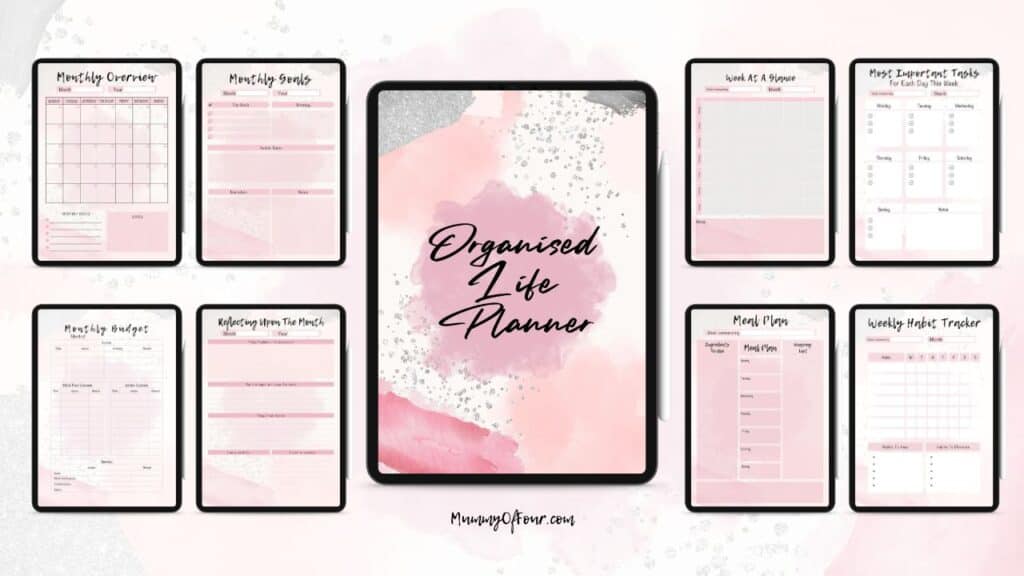
My Planner
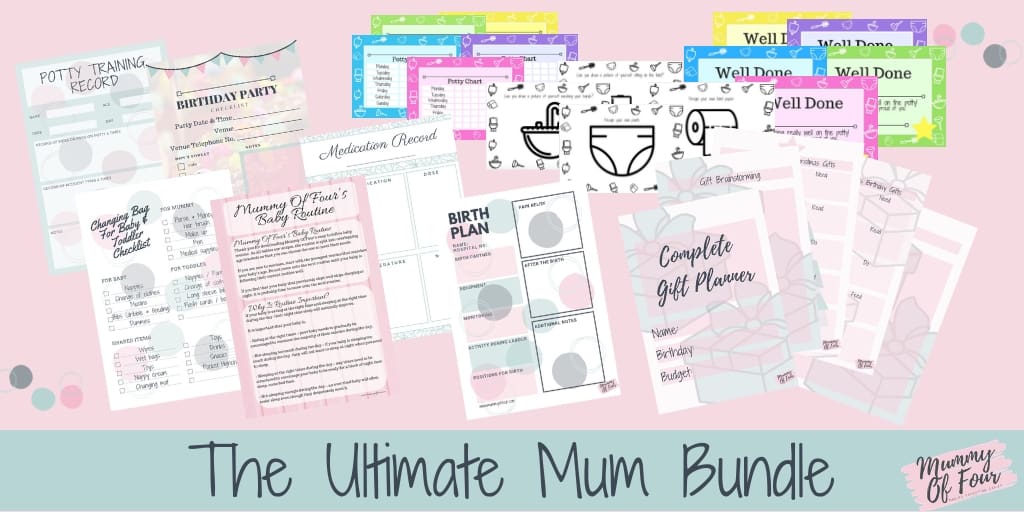
Get The Ultimate Mum Bundle Now
Join my email club and get your hands on my free “Ultimate Mum Bundle” of organisation printables.
Get A Free Audio Book From Audible

Read It Next
