
As you may know, 2 of my 4 children have been diagnosed with autism. I get lots of questions from Mums worried that their child might also have autism. They each ask which signs to look out for and what they should do with their concerns. Read on or watch the video below for the sign of autism to look out for and the advice that I always give.
Table Of Contents
It Is Worth Remembering
I am not a doctor, nor an autism specialist. I am, however, a Mum of a child with Autism that knows quite a lot about it. If you have any concerns about your child’s health or development, it is important to speak to your health visitor or GP.
There are a number of signs that may indicate that your child has ASD (autism spectrum disorder). While your child may exhibit some, or even all of these signs and still be neurotypical (the term used for someone who is not on the spectrum), if your child shows any of these signs, please speak to your health care professional.
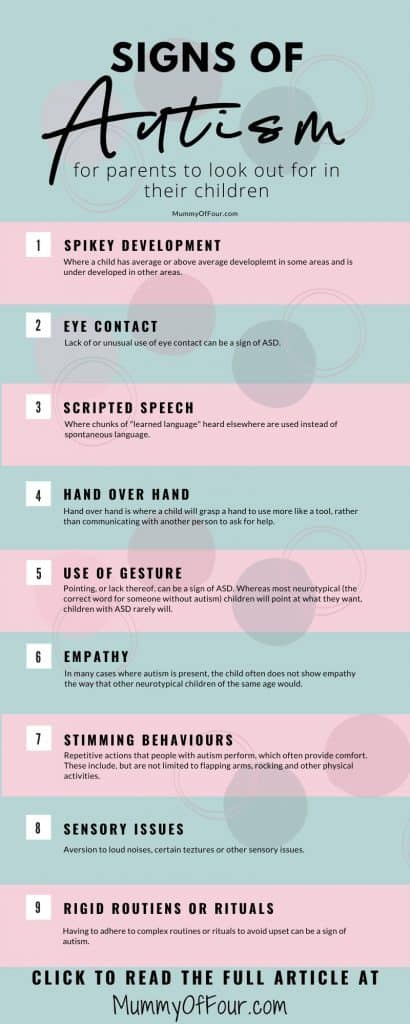
“Spikey” Development
During the process of my son’s diagnosis, the term “spikey development” was used a lot. All that this means is that a child may be doing well in one area of development and behind in another. For example, when Will was diagnosed before his 4th birthday, he had a reading age of 6, yet spontaneous language equivalent to a 1-year-old. These differences were said to be one indicator of Autism.

Eye Contact
Does your child make eye contact when you speak to them? Or when they speak to you? Do they make eye contact when attempting to get your attention? Lack of eye contact could be a sign on ASD.
Scripted Speech vs Spontaneous Language
Scripted speech is where chunks of language heard elsewhere are used instead of spontaneous language. For example, my son would regurgitate lines from TV shows such as Peppa Pig to make his point and communicate, rather than using his own words.
Hand Over Hand
Hand over hand is where a child will attempt to use your hand as a tool. For example, Will wanted me to fix a toy, rather than bringing it to me, he would take my hand and put it on the toy to fix it. In some cases, this can be a sign of autism.

Pointing & Other Gesture
Pointing, or lack thereof, can be a sign of ASD. Whereas most neurotypical (the correct word for someone without autism) children will point at what they want, children with ASD rarely will.
Most people with ASD do not naturally use gesture at all. While I often talk with my hands, for example, this is not usually something that you would see a person with autism doing.
Social Difficulties
In many cases where autism is present, the child often does not show interest in typical social situations the way in which neurotypical children of the same age usually would. Children with autism can often struggle to understand things such as sarcasm, taking things literally, interpreting jokes and other situations that neurotypical children may navigate more easily.
A large social difficulty that many children find is not being able to “read” other people easily. They may not be able to pick up on social cues indicating that people may be upset, bored or disinterested in what is going on.
Stimming Behaviours
Stimming behaviours are repetitive actions that people with autism perform, which often provide comfort. These include, but are not limited to flapping arms, rocking and other physical activities.

Aversion To Loud Noises
Luckily, loud noises are not something that bothers my son, but many children with ASD become incredibly distressed with even day to day noises.
Rigid Routines Or Rituals
My son is very concerned, like most children with autism, with routine being as it should be. He likes to know what is coming next and can become distressed if things do not pan out as he anticipates. For example, he became very upset one day because I bought “Carex Complete” instead of “Carex Protect Plus” hand soap, purely because it was not what he was expecting. To most people (me included), there was almost no difference, but to him, it felt like the end of the world.
Very Niche Interests
Children with autism can often be come very obsessed or fixated on certain items or topics. It could be anything from Thomas The Tank Engine, to maps, outer space, cars or anything else for that matter. These interests usually go beyond the typical childhood interest, with the child’s obsessions leading them to know everything thery can about their favourite subject.
Melt Downs
The the untrained eye, a meltdown can look an awful lot like a tantrum. I have found that the main difference is that while a neurotycial child may tantrum to get their own way, a tantrum can often be quite easily pacified. When a child with autism as a melt down, it can be more of a whole body experience that can take a long while to “come down” from.
Please remember
I am not a doctor. This is not an exhaustive list of symptoms. You may identify a number of these issues in your child, yet they might not have autism. Conversely, your child may have none of these difficulties, or different difficulties altogether, and still have autism.
The most important thing that I want you to know
No, I am not a doctor, but if you have any concerns at all that your child may have autism or any other difficulties, you must see one.
Many parents worry that seeking help will lead to an unnecessary diagnosis
Having been through the diagnosis process myself with my own son, I can confidently say that it is so thorough, they will never diagnose a child with autism that is not in fact on the spectrum. The diagnosis process is non-invasive and caused my son no distress whatsoever.
So where is the harm in checking?
Trust your gut, Mama. If you have concerns, speak to your health visitor or GP asap. Where’s the harm? Maybe it will all have been for nothing and your concerns will turn out to be unfounded. Maybe in a couple of years time, you will laugh that you ever worried. If that’s the case, great! No harm done.
But if your concerns are valid and/or child has ASD or some other developmental issue, I cannot stress enough that the sooner you get the problem identified, the sooner strategies will be put in place and the easier your lives will be.
Read It Next
Fancy Getting Your Hands On My Ultimate Mum Bundle Resource?

Why Not Pin This For Later?

Comments 1
Thank you for the info I am hopeful to complete the testing on my 9 year old son